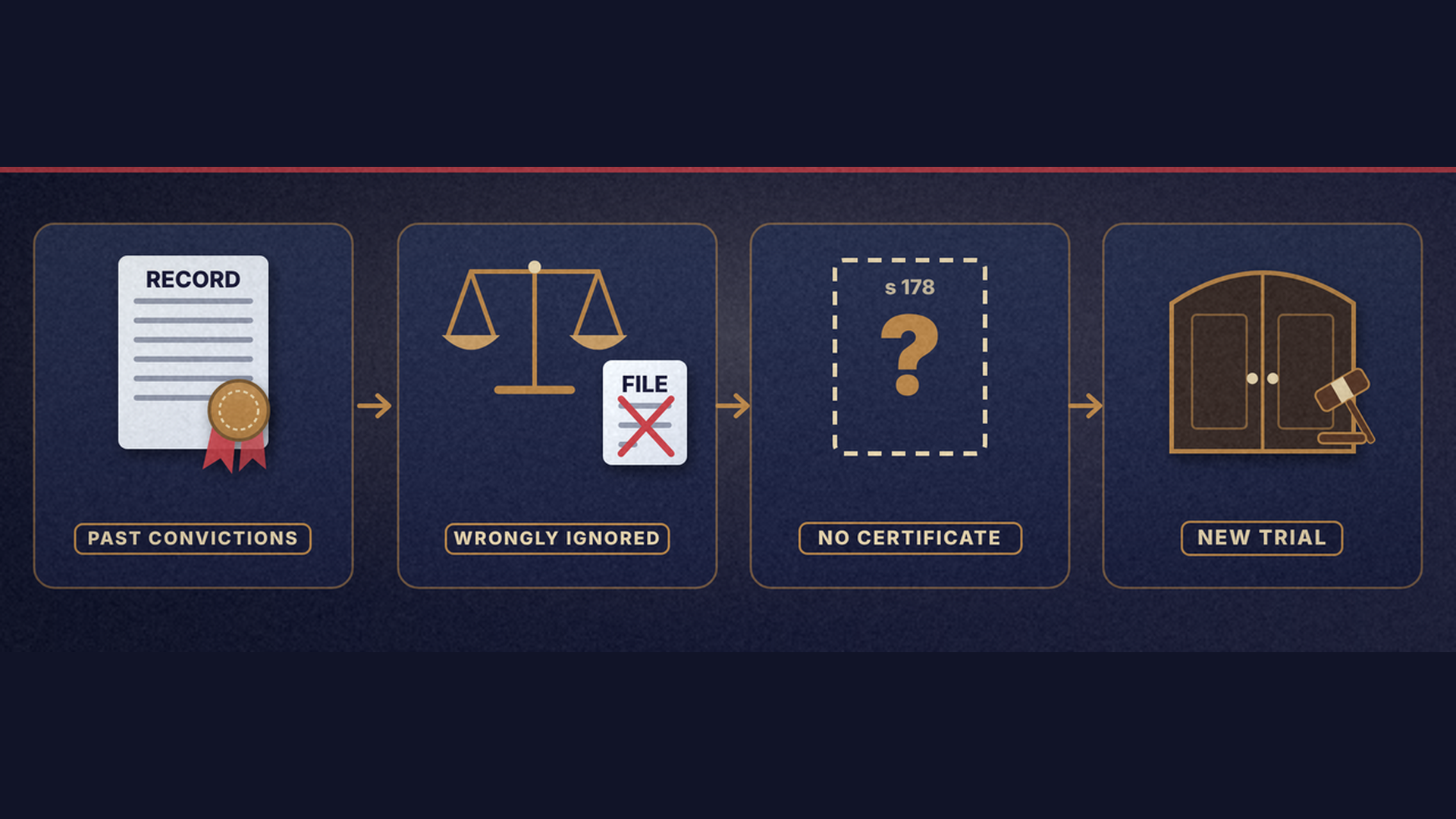
Criminal convictions can prove abuse in a civil claim, but their weight needs a new trial
In Estate of Croft v MTH [2026] HCA 44, the High Court of Australia unanimously allowed in part an appeal from the NSW Court of Appeal. A self-represented woman, known by the pseudonym MTH, sued the estate of her late foster carer for damages for abuse. He had been convicted of sexual offences against her before he died. The Court held that the trial judge was wrong to treat the convictions as no evidence of the abuse, because s 92(2) of the Evidence Act 1995 (NSW) made them admissible to prove it. But the Court of Appeal was also wrong to decide the case "as if" a certificate of conviction had been tendered when none was. A new trial was ordered. All paragraph references below are to the judgment.
Why it matters: Many civil abuse claims follow a criminal conviction. In a civil case the conviction can prove that the offences happened, and the other side must point to something that answers it. But it is not automatically decisive: its weight is for the trial judge, and the claimant must still prove the case. The Court also clarified how far a judge must go to help a self-represented party.
At a glance
- Court and level: High Court of Australia (final appeal court), five justices
- Area of law: Evidence (convictions in civil proceedings); assault claims; appeals; self-represented litigants
- Decision type: Appeal by special leave from the NSW Court of Appeal, heard 10 June 2026, decided 11 November 2026
- Outcome: Appeal allowed in part (5:0); judgment for the claimant against the estate set aside and a new trial ordered (Order 3)
- Reasons: one joint judgment of Gageler CJ, Gordon, Edelman, Steward and Beech-Jones JJ ([1]–[77])
- Standard of review: appeal by way of rehearing, a "real review of the trial" on the actual record ([48])
- Costs: the estate pays the amici curiae's costs; otherwise no order in the High Court; earlier costs await the new trial ([76])
🧩 Facts and Issues
Background
As a teenager in State care, the claimant was placed in temporary foster care with the deceased and his wife ([1]). In 2019 a jury convicted him of five sexual offences against her, committed while she was in his care, and of offences against another child ([2], [10]–[11]). His conviction appeal failed. He died before his special leave application to the High Court was heard, and it was dismissed because no orders could be made ([12]). She had sued him for assault, and sued his wife and the State in negligence; his estate replaced him as defendant ([2]).
How the case got here
The claimant represented herself at trial ([3], [14]). Her statement referred to the convictions ([14]). The estate accepted "the fact of the charges, the convictions" but denied any abuse ([15]). The trial judge (Cavanagh J) assumed she was not relying on the convictions and repeatedly said s 91 meant a conviction "is not evidence of the fact" behind it. Finding her evidence unreliable, he dismissed the claim ([15], [17]).
The Court of Appeal (Adamson JA; Mitchelmore JA and Price A-JA agreeing) held that the judge misunderstood ss 91, 92 and 178, "positively misle[d]" her, and denied her procedural fairness by not telling her about tendering a certificate of conviction ([20]–[23]). It decided the case "as if" a certificate had been tendered, treated the convictions as of "high probative value", accepted her evidence and entered judgment for $1,346,000 ([19], [21], [24], [26]). Her claims against the wife and the State stayed dismissed ([25], [27]).
What each side argued
The estate's four grounds attacked the duty the Court of Appeal imposed on the trial judge, its finding that he disregarded the convictions, its "as if" approach, and its reassessment of damages ([52]–[53], [62], [67]–[68]). The claimant appeared for herself, and senior and junior counsel appeared as amici curiae (friends of the court) to answer the estate ([27]).
The issues
- Could the claimant use the convictions to prove the abuse against the estate?
- What weight does a conviction carry, and what burden does it create?
- How far must a judge help a self-represented plaintiff?
- Could the Court of Appeal decide the facts itself?
⚖️ Applicable Law – Legislation, Rules and Principles
- Evidence Act 1995 (NSW), s 91(1): evidence of a decision in another proceeding "is not admissible to prove the existence of a fact that was in issue in that proceeding" ([29]–[30]).
- Evidence Act 1995 (NSW), s 92(2): in a civil proceeding, s 91(1) does not stop use of evidence that "a party, or a person through or under whom a party claims, has been convicted of an offence", unless a review or appeal is "not finally determined" or the conviction is quashed or pardoned ([29], [32]).
- Evidence Act 1995 (NSW), s 178: a court certificate can prove a conviction and, if stated, the particular offence ([46]–[47]).
- Evidence Act 1995 (NSW), s 191: agreed facts need no further proof ([49]).
- Supreme Court Act 1970 (NSW), s 75A: appeals to the Court of Appeal are by way of rehearing ([48]).
📌 Authorities Relied On
- Hollington v F Hewthorn & Co Ltd [1943] KB 587: the old rule that a conviction cannot prove its underlying facts, which s 92(2) was designed to change ([31]).
- Gonzales v Claridades (2003) 58 NSWLR 188, endorsed in Osborne v Butler (a pseudonym) (2024) 73 VR 386: s 92(2) puts an evidentiary onus on whoever disputes the conviction, without shifting the legal onus ([42]–[44]).
- Purkess v Crittenden (1965) 114 CLR 164: an evidential burden is a burden to introduce evidence ([44]–[45]).
- United Mexican States v Cabal (2001) 209 CLR 165: a special leave application is not an "appeal" ([37]).
- Fox v Percy (2003) 214 CLR 118: rehearing means a real review of the trial on the record ([48]).
- MacPherson v The Queen (1981) 147 CLR 512: the "effective choice" duty owed to an unrepresented accused ([60]–[61]).
- Nobarani v Mariconte (2018) 265 CLR 236: patience with unrepresented parties, without compromising impartiality ([55], [61]).
🧠 Analysis
Issue
Could the convictions prove the abuse, what did they do to the burden of proof, and having found error, should the Court of Appeal have decided the facts or ordered a retrial?
Rule
Section 92(2) lets a conviction prove, in a civil case, the facts that make up the elements of the offence ([32]–[33]). It does not fix the conviction's weight or presume it correct. It gives the person disputing it an evidential burden, while the claimant keeps the legal onus of proof ([41]–[45]).
Application
The convictions were admissible against the estate
A conviction proves only the elements of the offence, not sentencing remarks or other findings ([33]). The deceased was a "person through or under whom" his estate claims, because his liability passed to the estate when he died ([34]–[35]). His special leave application, dismissed after death, was a final determination, so s 92(2)(a) did not block the evidence ([36]–[38]).
No certificate was needed, because the convictions were agreed
Section 178 is only one way to prove a conviction and is not essential to s 92 ([47]). The convictions were agreed facts, so s 92(2) was engaged ([49]). They were prima facie evidence (enough to prove a fact unless answered) that the offending acts occurred, supported her account, and placed an evidential burden on the estate ([50]–[51]).
The trial judge was wrong to put the convictions aside
Her statement referred to the convictions, so there was no basis to find she was not relying on them ([63]). The judge's credibility findings were made without weighing that evidence ([64]–[65]). Even if the convictions rested mainly on her own evidence, they had added value because of the criminal standard of proof (beyond reasonable doubt) ([65]). The Court of Appeal was right to intervene ([66]).
But the judge had no duty to run her case for her
The Court of Appeal said the judge had to "ensure" she did not "fail to claim rights or put forward legal arguments". The High Court called that "far too absolute": it would require judges to imagine every argument for one side and risk their impartiality ([55]). There was no duty to tell her to get a certificate when the convictions were not disputed ([57]). The criminal "effective choice" duty does not carry across to a civil plaintiff who bears the burden of proof. A judge must patiently explain rules and procedures, but fairness "does not entail an obligation to provide running advice" ([60]–[61]).
The Court of Appeal could not decide the case on a hypothetical certificate
An appeal court must review the actual record, not a certificate that was never tendered ([48], [67]). It also wrongly treated every conviction as highly probative. The weight of a conviction "can vary greatly" and is for the trial court ([39]–[41], [70]). With no other witnesses, these convictions appear to have rested mainly on her evidence, which bears on weight ([70]). The estate only had to introduce evidence or point to circumstances capable of rebutting the convictions. No court asked whether it did, or whether she discharged her legal onus ([71]–[73]).
Conclusion
The trial miscarried. Because the result turns on credibility findings that must be made with a proper assessment of the convictions' weight, a new trial was required ([74]–[75]).
🏛️ Outcome, Orders and Costs
- Orders 1–3: appeal allowed in part; the Court of Appeal's orders (3) and (5) set aside; the trial judge's dismissal of the claim against the estate, and related costs orders, set aside; that claim to be retried.
- Order 4: the estate pays the amici curiae's costs, as it undertook ([76]).
- Order 5: appeal otherwise dismissed. There is no other High Court costs order, and costs of the trial and the Court of Appeal between these parties await the new trial ([76]).
- The Court noted the parties can still settle "without further hearing, delay and cost" ([76]).
🧭 Practical Lessons
- For self-represented litigants: If the person you are suing was convicted of offences against you, say clearly that you rely on the conviction to prove the facts, not just as background ([49], [63]).
- For self-represented litigants: A conviction proves only the elements of each offence. Other conduct you allege, and your losses, still need evidence ([33], [59]).
- For self-represented litigants: The judge must explain the rules fairly but will not plan your case ([61]).
- For practitioners: An admission or agreed fact about a conviction engages s 92(2). A s 178 certificate is not essential ([47]–[49]).
- For practitioners: When defending, the evidential burden is real but limited. Identify evidence capable of rebutting the convictions and address their weight ([45], [72]–[73]).
- For practitioners: On appeal, argue from the record. An appeal court cannot rely on evidence that "would have been available" ([48]).
🧠 Take-Home Lesson
- A criminal conviction can prove, in a civil case, that the offence happened, including against the offender's estate.
- It shifts the burden of producing evidence, but the claimant must still prove the case, and the conviction's weight is for the trial judge.
- Judges must be fair to self-represented parties, but they are not their lawyers.
"A conviction is evidence, not a verdict in your civil case. Rely on it, and still prove your claim."
This digest is general information about a published judgment, not legal advice. For advice about your own situation, speak to a lawyer, Legal Aid or a community legal centre.